





It was more than 40 years ago that LNG was first introduced to Japan. Even before the March disaster, the Japanese government in its revised “Basic Energy Plan” had positioned LNG as the core energy source in the country’s supply mix over the long term.
 |
|
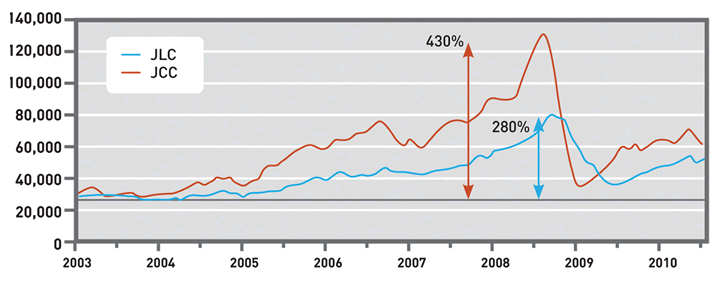
Figure 1: Close linkage between Japan Crude Cocktail and Japan LNG Cocktail |
Based on this shift in its energy policy, the government will expand LNG use while drastically reducing emissions of greenhouse gases. Japan will maintain its leadership position as an importer in the world LNG industry.
Now, the first question that may be raised is whether LNG would be a bridging energy or would it continue to be a core energy source for Japan and for Asia.
Questions
When oil prices are again high at over $100 per barrel, I have to question whether it is viable for LNG to be price indexed to crude oil in Asia when it does not reflect the circumstances of the current market.
When considering oil-indexed LNG one must examine the S-curve pricing mechanism, and its role in the past and in the future in expanding demand for LNG in Japan.
I believe that an effective pricing formula that enables the growth of the Japanese LNG market would also help to realize an expansion of LNG demand in Asia as a whole.
As a result, both producers and consumers would be able to enjoy a continuous growth of their businesses. This, I believe, would achieve a win/win result for all parties in the LNG industry.
Reviewing the drastic energy price fluctuations during the past few years and their implications on the Japanese LNG market, Figure 1 shows the price trends of the Japanese Crude Cocktail (JCC) and the Japanese LNG Cocktail (JLC) after 2003 in which their average prices are compared on the thermal equivalent basis per ton of LNG.
Instability
We see here that the JCC started to rise after 2004 and surged in 2007. After these changes, JCC prices dropped drastically in the latter half of 2008.
The JLC, on the other hand, with some time lag compared with the JCC, shows similar price trends, indicating a strong price linkage between the two. Looking at the fluctuation levels, however, the JCC fluctuated by 4.3 times and the JLC by 2.8 times.
The smaller fluctuation range of the JLC is an effect of the S-curve pricing mechanism adopted in many price formulas. When it was first introduced to Japan,
LNG was viewed as a substitute for oil, particularly for power generation. Because of this, a pricing formula indexed to the JCC was adopted in many LNG projects for Japan.
During the mid-1990s when crude oil prices were stagnating, a new LNG pricing formula was introduced for the purpose of moderating the level of LNG price decline when crude oil prices dropped.
S-Curve
Called the S-curve, the formula was designed to moderate LNG price rises when oil prices were increasing. This mechanism, therefore, relieved producers of the price impacts when oil prices were low and it also eased the high price pressures for buyers.
The formula has also realized benefits of stabilizing the price of LNG compared with crude oil. Further, when combined with a benefit of stable supply by pipelines in Japan, LNG could enjoy added value of higher stability of price compared with its competing fuels.
Turning to surging energy prices, there are various effects energy price spikes have had on the gas demand in Japan.
Fuel switch
Firstly is the accelerated fuel switch from oil to natural gas in the industrial sector because of higher price competitiveness of gas against oil. Secondly, the economic recovery with its strong appetite for capital investment, and higher environmental consciousness, boosted the demand for gas.
Thirdly, despite boosted gas demand due to fuel switching, gas equipment such as cogeneration systems that compete with electricity, experienced a decline in their competitiveness, discouraging their market expansion.
The energy price fluctuations and the subsequent decline in demand in the market could be summarized in the following three points:
1. Increased energy costs pressured profits of businesses, and when coupled with the global economic recession, demand for natural gas experienced a temporary decline.
2. An increasing number of industrial customers took various actions due to uncertainty in their business outlook, including business down-scaling, integrating and transferring overseas their production activities. This trend reflected their difficulty in making tough decisions on capital investment which require long pay-back time, and it slowed down the pace of fuel switching.
3. After experiencing price fluctuations, though smaller in their ranges than oil, natural gas suffered a reputation damage of its ‘price stability’ which was its major selling point. As I have described, natural gas experienced a temporary boost in its demand when oil price surged, but it later had a negative impact on Japanese gas customers for its price uncertainty.
 |
|
Figure 2: Changes in the JCC and their impact on the payback time for cogeneration systems. A JCC of $60 and higher extends the payback time |
While we are currently experiencing gradual price increases of crude oil, customers in Japan have serious concerns over possible spikes of energy prices.
Such uncertainty on the part of energy users has been at the root of the failure of gas demand to increase substantially, despite general economic recovery in Japan.
Industrial use
There are two major uses for natural gas in Japan, power generation and gas distribution. When Japan started imports of LNG, it was used mostly for power generation. During the last 20 years, LNG demand for gas distribution has grown fast and now it accounts for 40 percent against 60 percent for power generation.
Looking at the trend of gas demand for industrial uses, it accounted for 50 percent of total gas demand in the gas distribution market in the country, which was 18 billion cubic metres or 15 million tonnes of LNG.
When LNG was first introduced, industrial consumption stood at mere 500 million cubic metres, or 11 percent of total gas demand in a given year.
The impressive growth of natural gas demand for industry has been made possible by the higher environmental advantages and the expanded use of natural gas for advanced gas utilization such as cogeneration.
Looking at the economics of natural gas compared with oil, end-use gas prices have additional cost elements such as pipeline transmission and distribution and safety costs at customers’ premises.
Costly
The higher fuel cost of natural gas makes it more costly for manufacturers to convert to gas from oil.
The price of gas, however, becomes more affordable when combined with the installation of energy-saving equipment such as cogeneration systems, which minimize utility bills including grid electricity charges.
According to the “Basic Energy Plan” adopted last year, “promotion of fuel shift to natural gas” aims to double the proportion of natural gas in the industrial sector from recent levels by 2030 as part of the government’s measures against global warming. Based on this goal, it forecasts a 25 percent increase in gas demand from Japanese gas utility businesses in the next 20 years.
The Plan also sets forth a target of 50 percent increase of cogeneration capacity up to 8 gigawatts by 2020, and it will more than double to 11 GW by 2030.
Core fuel
The Plan therefore, foresees a future energy situation in Japan in which natural gas is positioned as a core energy source to realize a low-carbon society in 20 years.
The Plan recognizes cogeneration systems as the most effective means to achieve the goals of reducing CO2 emission.
To ensure the growth of the LNG in the market, it will be important to achieve further development of the mature Japanese gas industry.
For this purpose, it is essential to realize growth of gas demand through cogeneration in the industrial sector which has been positioned as an effective instrument in achieving a low-carbon society.
To do so, economical and stable gas pricing must be realized.
The advantage of cogeneration systems on the basis of running costs depends largely on differences between gas and electricity rates.
In the case of electricity rates in Japan, power companies reflect proportionally the price fluctuations of thermal fuels such as coal, oil and LNG in their portfolio of fuels for electricity.
Hydro and nuclear are not subject to the same price fluctuations as thermal fuels, whose costs are linked to the LNG price.
This means that, when fuel prices get higher, the price competitiveness of cogeneration becomes smaller. The advantages of cogeneration in its running cost changes according to the LNG price.
When a slope of an LNG pricing formula is placed at 14.85, which is said to be a traditional slope, economic advantages of a 7 megawatts turbine driven system is halved as the JCC price increases from $40 to $70, and it is reduced to 1/10 when the JCC is at $100.
With such a calculation, it would be difficult to depreciate the capital cost of the cogeneration systems, let alone realize an expansion of cogeneration in the energy market.
Conversely, to realize the original economic advantages of cogeneration, it has been calculated that a slope of LNG pricing should be less than 8.
I calculated a relationship between the JCC and the payback years for a cogeneration system based on existing electricity and gas prices. (See Figure 2) The payback time gets much longer when the JCC goes beyond the $60 to $70 range. However, the current JCC price level goes far beyond the upper limit for promoting cogeneration systems in Japan.
If we are to realize continued expansion of natural gas in the industrial energy supply, it will become necessary to control the price linkage between LNG and oil in the high price ranges of oil.
It should prove effective, therefore, to introduce the S-curve in the LNG pricing formula for the purpose of moderating a slope in the high price range of oil.
Furthermore, the S-curve could be a step forward to move away from the crude oil-linked pricing formula to realize a truly competitive pricing for LNG.
Another element which requires price stability for natural gas is developing pipeline infrastructure for ensuring growth of gas in the industrial sector.
Concentration
Pipeline networks in Japan are fragmented and they are only established to serve major economic regions, centring on Tokyo, Osaka, and Nagoya.
This means that gas demand is concentrated in those regions where industrial gas for thermal applications has seen high market saturation. In the case of Osaka Gas, natural gas accounts for about 80 percent of the heat demand in this sector. This means that more potential industrial gas demand is located in those places outside the reach of the pipeline network.
Infrastructure
It is therefore essential to improve pipeline infrastructure in the country. Enormous investments for pipeline construction must be recovered through the continued growth of gas demand over the long term.
Assuming industrial heat demand, excluding that of coal, is met by natural gas in the whole service area of Osaka Gas, it would be equivalent to 30 million tonnes of additional LNG demand.
In order to achieve sustainable growth of the LNG industry in Japan, potential demand needs to be cultivated and the necessary infrastructure has to be developed.
Japan has even more significant growth potential for LNG because of the country’s positioning of natural gas as a key energy source towards a low-carbon society.
Critical
In order to realize more growth of LNG demand, two points are of critical importance. One is greater expansion of cogeneration systems in the country, and the other is to develop pipeline networks beyond the existing geographic locations.
To achieve these objectives, price stability of natural gas needs to be enhanced at the time of rising oil prices, and thereby maintaining its price competitiveness.
To improve price competitiveness of LNG indexed to crude oil, I believe an effective solution would be to revive a price formula with the S-curve.
Looking at the overall Asian market, LNG is expected to replace coal rather than fuel oil. This is because of fuel switching for power generation from coal to natural gas in these countries over the short to medium term.
Such a development makes a striking contrast with Japan where LNG was first introduced as an alternative fuel for oil.
Potential
It is true that there exists tremendous potential demand for natural gas in Asia. There are doubts, however, about such a growth possibility under the current price trends of oil at $100 per barrel to which LNG price is indexed.
Price increases of LNG would significantly affect the demand for natural gas in the Asian economies. Also in looking at the demand in China and India, the influence of their domestic gas should not be neglected.
By drawing an example from Japan, it should prove important to develop gas demand for manufacturing industries through construction of pipelines to achieve long-term and stable development of the LNG industry in Asia.
LNG pricing is an important element in ensuring such growth, and if it is unfavourable, it may affect the necessary advances in market development.
Asian driver
The growth of gas demand in Asia may also affect the world LNG industry which relies on Asia as a driver for business development. Difficulties in developing new projects may hinder the industry and endanger the soundness of the market.
To realize a sustainable growth of the LNG industry, it is essential to achieve a cycle for growth in the LNG chain; growth in demand to enable new LNG projects for stimulating growth of the entire sector, which in turn would enhance price competitiveness of LNG.
Viewing the entire LNG industry from a perspective of achieving growth in the future, it should become necessary to weaken the linkage of the Asian LNG price with oil. I believe incorporating the S-curve in the pricing mechanism is a positive step forward to achieving this objective.
Naoto Nakamura, Osaka Gas, Osaka, Japan




